
Historical background
- rurmus project -
More than a water wheel
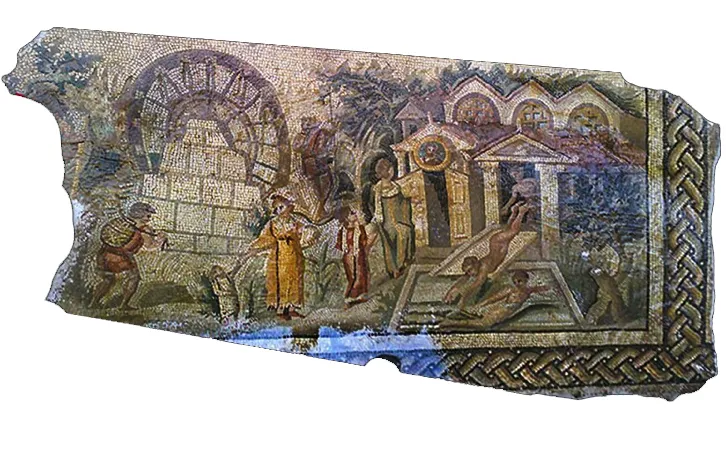
“Rurmus” devices—systems utilizing a water wheel to lift water—rank among the oldest technical solutions employed by humans to secure access to water. Their development was closely linked to the need to transport water to higher elevations, particularly in locations where natural flow was insufficient.
In Europe, such systems began to emerge during the Middle Ages, driven by urban growth and an increasing demand for water. In Poland and other Central European countries, water wheels were used to power water supply systems that delivered water to castles, monasteries, and urban areas.
Cities such as Kraków and Poznań utilized devices capable of lifting water from rivers and transporting it to higher-lying parts of the built-up area. Often constructed as part of the municipal infrastructure, these systems played a vital role in the functioning of the city. Water was collected in reservoirs and subsequently distributed via wooden pipes.
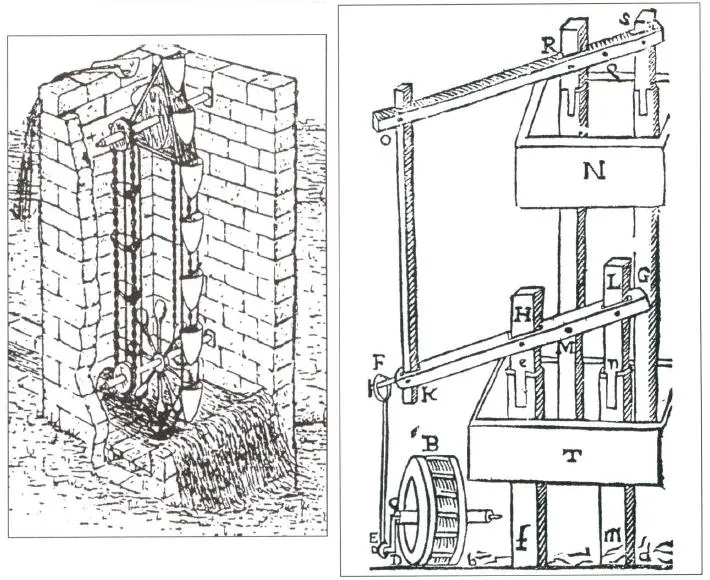
Left: Water-wheel-driven bucket elevator – based on Philo’s description from 230 BC | Right: Structure of a pumping mechanism.
Illustrations from the book *Wodociągi Krakowa* (Water Supply Systems of Kraków)
- rurmus project -
Hydropower
These solutions were relatively simple yet effective. They operated based on fundamental principles of physics and required no external energy sources. Consequently, they were self-sufficient and could function for extended periods with minimal maintenance.
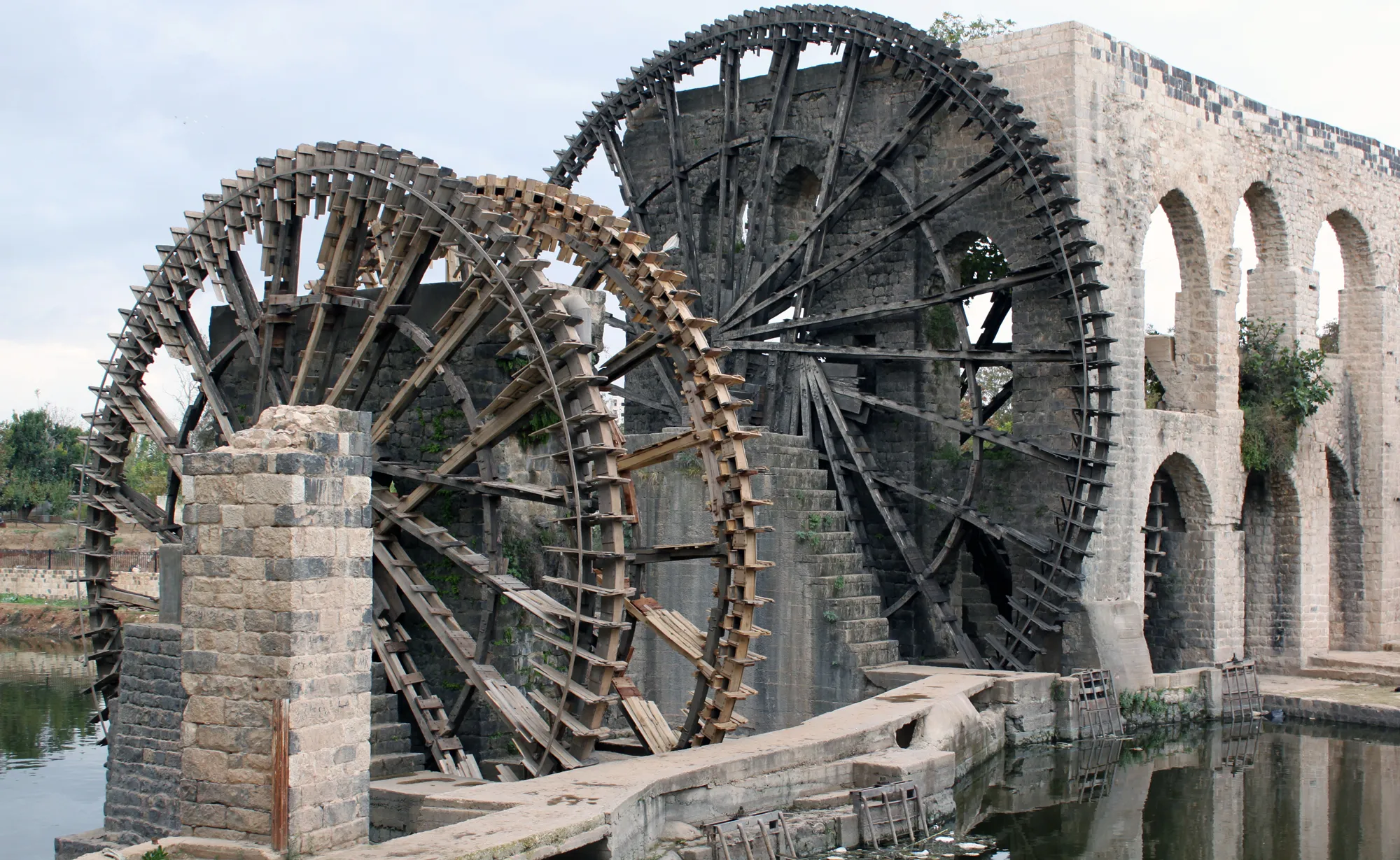
Similar devices were developed concurrently in other parts of the world. In the Middle East and North Africa, systems known as bucket wheels were used to lift water from rivers and wells. They were primarily employed for irrigating agricultural fields.
In Africa and parts of Asia, such systems remain in use today in simplified forms. Water wheels, often constructed from local materials, are used to convey water to farmland. While their design is adapted to local conditions, the operating principle remains the same.
In these systems, water is drawn from a river or canal and then lifted by a rotating wheel equipped with buckets. Upon reaching the necessary height, the water flows into irrigation channels that distribute it across the fields. This method enables land irrigation without the need for pumps or electricity.
Similar solutions were also employed in Western Europe, particularly in regions with extensive networks of canals and rivers. Water wheels were used not only for lifting water but also as a power source for mills, sawmills, and other industrial machinery.
The *Rurmus* water supply system represented an evolution of these concepts. It combined the function of lifting water with its transport and distribution, thereby enabling the water supply to cover larger areas and serve more complex urban structures. It is worth noting that, despite technological advancements, the fundamental operating principle of these devices has remained unchanged for centuries. It still relies on harnessing the energy of water and its movement. Modern solutions are more advanced, yet their foundation remains the same.
- rurmus project -
Yesterday and today
It is interesting to note that such devices are still used in many parts of the world because they operate independently of an electricity supply. In regions with limited energy infrastructure, these solutions remain practical and effective.
The *Rurmus* fits into this historical progression of technological development. It exemplifies a solution that combines simplicity with functionality. Observing it in operation offers a better understanding of what early water supply systems looked like.
From an educational standpoint, it is important to demonstrate that many modern solutions have their roots in simple mechanisms developed centuries ago. The *Rurmus* is one such example.
This installation also allows for a comparison between historical and contemporary methods of water usage, fostering a better understanding of water as a resource and the ways it is utilized.
The history of the *Rurmus* illustrates that technological progress does not always involve creating entirely new solutions, but often entails refining existing ones; the water wheel and bucket system are prime examples of this.
The modern reconstruction of the *Rurmus* enables these systems to be recreated and presented to a wide audience, thereby preserving knowledge of past technologies and passing it on to future generations.
As an educational installation, the *Rurmus* serves not only as an example of a specific device in action but also as part of the broader history of technology. It demonstrates how people throughout the ages have utilized available resources to solve challenges related to water access.
Similar solutions remain in use in many parts of the world, confirming their effectiveness and versatility. Regardless of time or place, the operating principle remains the same, making Rurmus a timeless solution.
- Education - Folklore - Culture -
Contact us—we have the knowledge, experience, and international connections.
Together, we will develop and implement your idea.