
Description of the mechanism of action of Rumurus

- rurmus project -
upward water transport
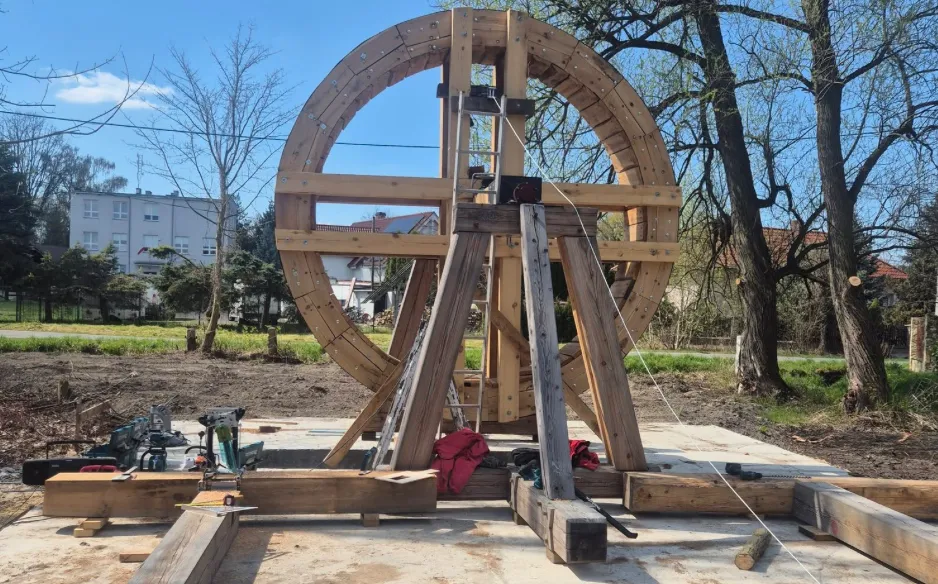
The operating mechanism of the Rurmus relies on utilizing the potential energy of water supplied to the upper part of a water wheel and converting it into mechanical energy in the form of rotational motion. The system’s core component is an overshot water wheel, which operates based on the gravitational drop of water. Water is fed to the wheel’s highest point, where it acts upon the blades or buckets, generating torque.
The mechanism begins to operate when water is introduced into the supply channel. Moving under the force of gravity, the water reaches the upper section of the water wheel. Depending on the design, it may be directed into specially shaped buckets or onto the surface of the blades. The weight of the water acting on these working elements creates a force that generates torque relative to the wheel’s axis.
This force causes the water wheel to rotate. The motion is continuous, provided there is a constant supply of water. The wheel’s rotational speed depends on the volume of water supplied, the height of the drop, and the wheel’s design—including the number and shape of the buckets.
The rotating water wheel serves as the primary drive component of the entire system. Its motion is transmitted directly to the water-lifting mechanism, which is an integral part of the system. Depending on the chosen design, this mechanism may consist of a series of buckets mounted on the wheel’s circumference or a chain system coupled with the wheel.
In the bucket-based system, the buckets are evenly spaced around the wheel’s circumference. As the wheel rotates, its lower section passes through the water intake zone, where the buckets fill with water. The buckets are then lifted upward by the rotation. Upon reaching the highest point, they empty their contents into a receiving tank.
The receiving tank is the next component of the mechanism. Its purpose is to collect the water lifted by the bucket system and make it available for further use. Depending on the facility’s function, the collected water can then be discharged via gravity or utilized in subsequent processes.
…
- rurmus project -
craftsmanship and physics
A crucial component of the mechanism is the water wheel axle. This axle transmits torque and ensures rotational stability. It must be made of a material with sufficient strength and mounted in a way that allows for free rotation. The axle’s support points—the bearings—are critical to the overall system’s efficiency.
The axle bearing arrangement can be implemented in various ways, depending on the chosen technology. Traditional designs employed wooden or metal sockets, whereas modern constructions utilize rolling-element or plain bearings. The objective is to minimize motion resistance and ensure component durability.
The operating mechanism of the Rurmus relies on a continuous cycle of water intake, transport, and discharge. Each rotation of the wheel lifts a specific volume of water, resulting in a continuous flow over time. System efficiency depends on several factors, including the number of buckets, their capacity, and the wheel’s rotational speed.
A key aspect of the mechanism’s operation is the even distribution of the load around the wheel’s circumference. Uneven bucket filling could lead to vibrations and irregular operation. Therefore, ensuring a stable water supply and properly shaping the working components is essential.
The mechanism must also account for energy losses caused by motion resistance and water splashing. Some energy is lost due to friction at the bearing points and air resistance. These losses must be minimized through appropriate design and maintenance of the device.
In the absence of a water supply, the mechanism stops automatically. This means that its operation depends directly on the water supply conditions. While educational systems may incorporate auxiliary power sources, the fundamental operating principle remains the use of water energy.
The Rurmus mechanism exemplifies the practical application of simple physical principles. Converting the water’s potential energy into mechanical energy enables work to be performed without external power sources, making the system an efficient and eco-friendly technical solution.
Another crucial aspect is the synchronization of the mechanism’s various components. The water wheel, the bucket system, and the reservoir must work together to ensure continuous operation; a disruption in any single component directly affects the functioning of the entire system.
The mechanism is designed to be easily observed. Its open structure allows users to track the movement of individual parts and understand the device’s operating principles—a key feature of the facility’s educational function.
In operation, the mechanism requires periodic inspection and maintenance, particularly regarding moving parts such as the axle, bearings, and bucket connections. Regular maintenance ensures the device remains efficient and extends its service life.
The Rurmus mechanism relies on simple yet effective principles. Water delivered to the appropriate height sets the wheel in motion, which in turn drives the water-lifting system. This process repeats continuously, creating a closed operating cycle.
Despite its simplicity, the mechanism requires precision in its construction and the proper fitting of components. Only then can the system achieve smooth and stable operation. Thanks to this, Rurmus serves as an example of the effective use of natural energy sources and traditional technical solutions.
- Education - Folklore - Culture -
Contact us—we have the knowledge, experience, and international connections.
Together, we will develop and implement your idea.