
Rurmus
- project rurmus -
Water transport device
The *Rurmus* is not only a reconstruction of a historic water-lifting device but also an educational tool that allows visitors to learn about the operating principles of early water supply systems through hands-on observation. By watching the mechanism in action, visitors can see how water power was harnessed long before the advent of modern pumps and engines.
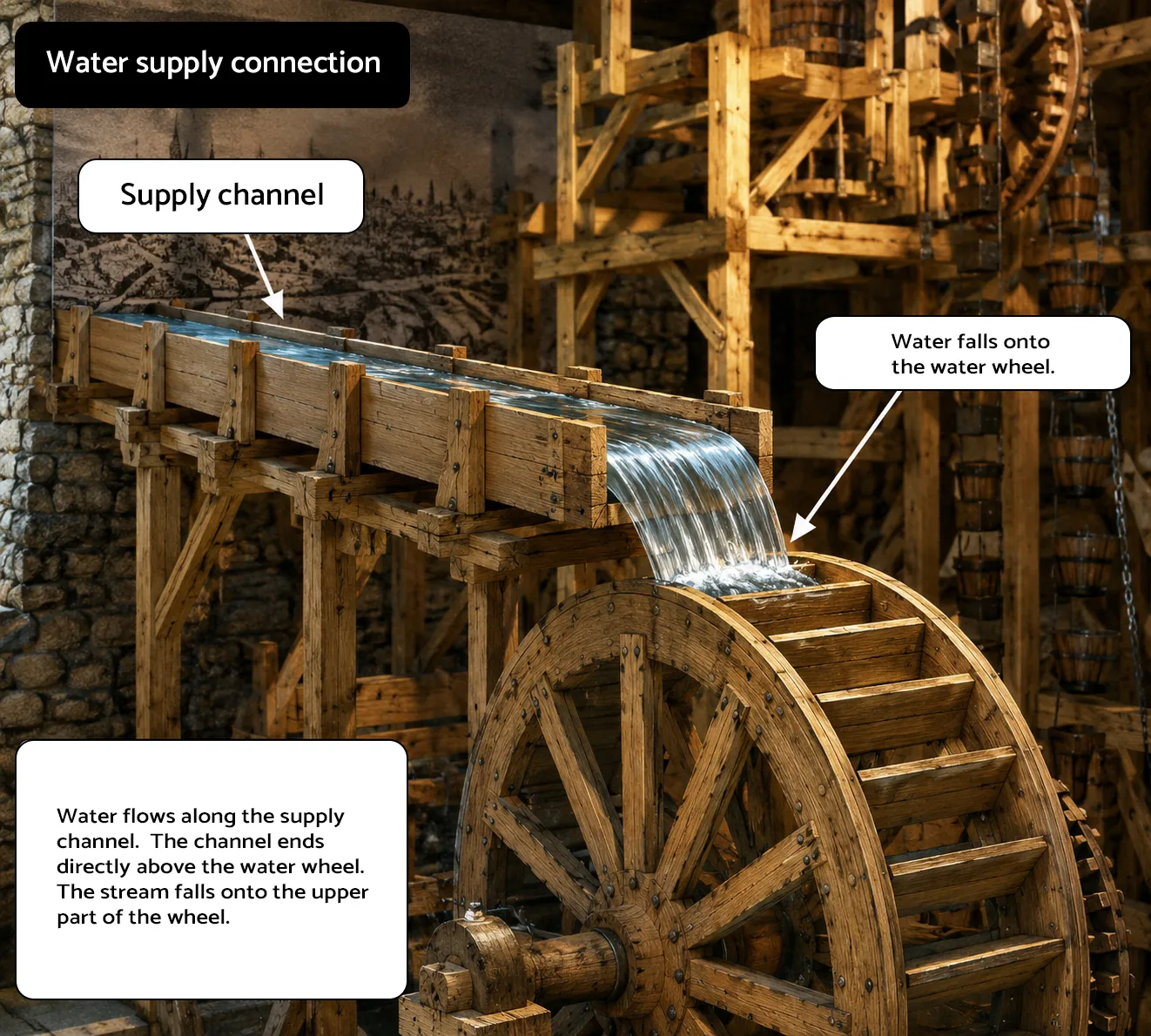
A key concept demonstrated by the *Rurmus* is the utilization of flowing water’s energy. Water possesses energy derived from both elevation differences and motion, which can be converted into mechanical energy. In the case of the *Rurmus*, this energy drives a water wheel, which in turn powers the mechanism that lifts the water. This serves as a practical example of fundamental physical laws—principles that remain constant regardless of the era or the technology employed.
- project rurmus -
Bucket system
Demonstrating the operation of the bucket-wheel system is also a key educational aspect. Water is drawn from a lower level, transported upwards by a rotating wheel, and finally discharged into a reservoir or distribution system.
For centuries, this solution enabled the water supply for towns, castles, monasteries, and farms without the need for external energy sources.
The *Rurmus* also offers insight into the construction of traditional wooden structures. Visitors can observe the posts, beams, braces, axles, bearings, and carpentry joints that combine to form a functional technical system. This allows for an understanding of the role of individual structural elements and the interrelationships between them.
An important topic presented at the site is the history of water supply systems and the evolution of water engineering. The *Rurmus* exemplifies solutions used in many European cities where it was necessary to lift water to higher-lying areas. It provides a better understanding of how historic cities functioned before the widespread adoption of modern water supply systems.

- project rurmus -
Traditional crafts
The presentation of traditional craftsmanship also forms a significant part of the educational message. The device’s construction showcases the artistry of past carpenters, who were able to build complex wooden mechanisms using techniques such as mortise-and-tenon joints, interlocking carpentry joints, and wooden pegs. This allows visitors to learn about the construction methods employed by craftspeople over many centuries.
The *Rurmus* can also be used to explain concepts related to renewable energy. The device relies solely on the energy of flowing water—requiring neither fuel nor electricity—thereby demonstrating that many historical solutions were environmentally friendly and based on harnessing natural processes.
Educational materials related to the *Rurmus* can take various forms. Information boards placed near the structure serve as the primary source of information. These can be supplemented by brochures, online resources, multimedia presentations, and descriptions available on the website. Consequently, information about the device remains accessible both during and after the visit.
Highlighting the importance of water as a vital natural resource is another key educational element. The *Rurmus* illustrates the immense effort people in the past had to exert to secure access to water, as well as the importance of using it wisely today.
By combining aspects of history, technology, physics, craftsmanship, and environmental protection, the *Rurmus* serves as a multifaceted educational tool. It allows one not only to observe the operation of a historic device but also to understand the technical and natural processes that have shaped the development of civilization over the centuries.
- Education - Folklore - Culture -
Contact us—we have the knowledge, experience, and international connections.
Together, we will develop and implement your idea.