
Planning and implementation of the Rurmus project

- rurmus project -
project planning and implementation
The construction of the Rurmus was not merely the execution of a technical design but also a practical exercise that revealed the many challenges involved in recreating historical devices at full scale.
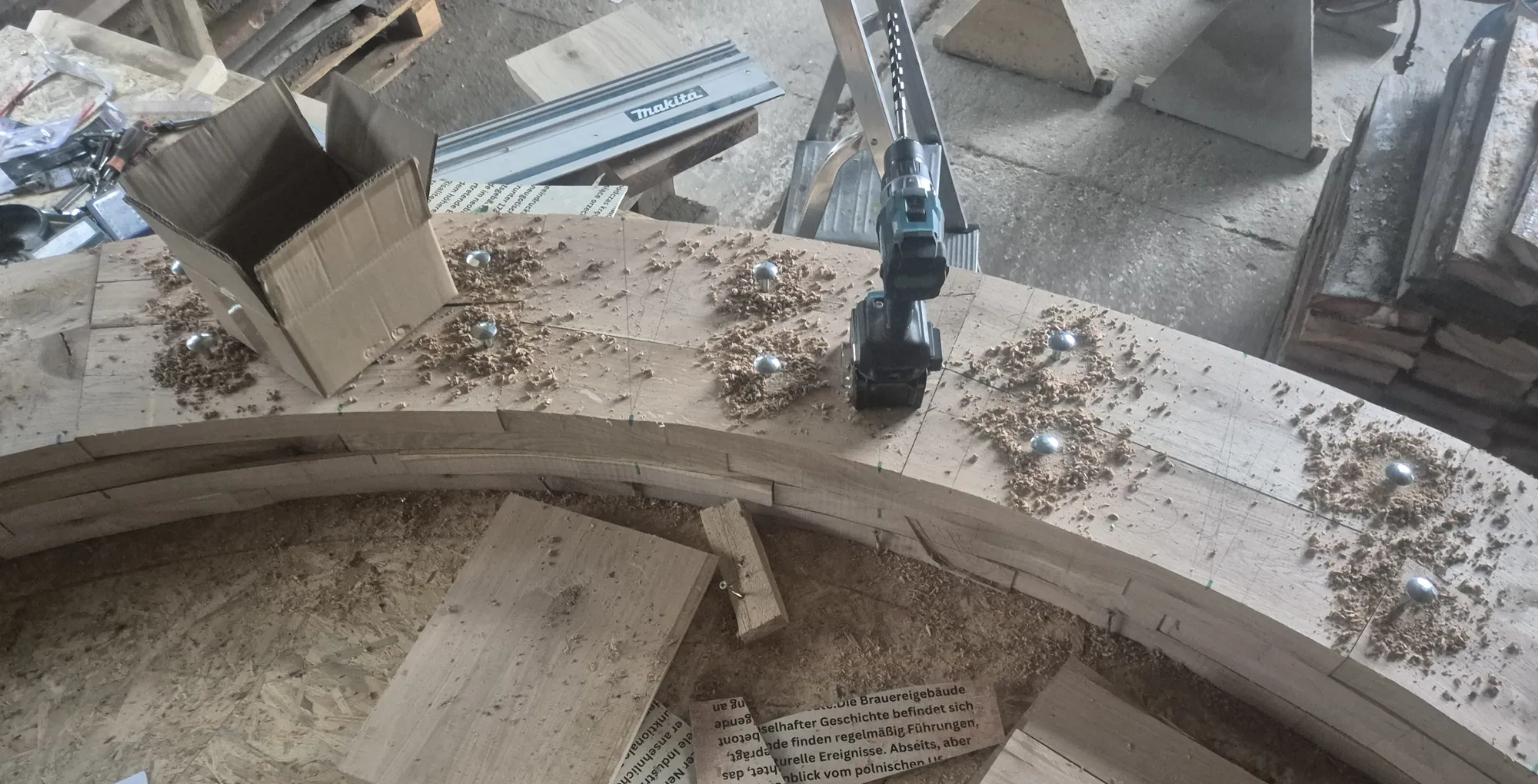
The water wheel was one of the most critical components of the entire structure. It was fabricated entirely in a carpentry workshop, where all structural elements could be prepared with precision. However, the assembly phase demonstrated that with large wooden structures, it is impossible to eliminate all clearances completely. Wood is a natural material that expands and contracts in response to humidity and temperature fluctuations; consequently, controlled assembly gaps were left between components to allow for subsequent adjustments to the structure.
Once the wheel was completed, a new challenge arose: transportation. The structure’s dimensions were so substantial that moving the finished component required special arrangements for an oversized load. This necessitated taking road restrictions into account, properly marking the transport, and implementing additional safety measures. The experience highlighted that, for projects of this nature, advance logistical planning is just as crucial as the actual fabrication process.
The assembly of the tower and the main structural components also provided valuable insights.
Initially, the use of traditional methods—such as pulley systems—was considered for lifting the heavy components. In practice, however, the weight and dimensions of the individual parts proved so significant that a crane was required to ensure both safety and assembly precision. This enabled the components to be positioned accurately and significantly streamlined the workflow. During assembly, the need for design modifications also became apparent. One of the most significant changes was adjusting the height of the water wheel axle supports. Initially, supports approximately one meter high were planned; however, assembly trials revealed that raising them to nearly two meters was necessary to achieve the correct system geometry.
…
- rurmus project -
flexibility and plan modifications
This change affected the entire drive mechanism. It was necessary to adjust the geometry of the component known as the “lamp,” which is responsible for transmitting power between the main shaft and the subsequent parts of the mechanism. The lengths of the components, operating angles, and support points were all modified. This demonstrated that even a minor alteration to a single element can impact the functioning of the entire system.
The work was carried out in stages, allowing for continuous monitoring of the structure’s geometry, verification of the functionality of individual solutions, and the implementation of necessary adjustments without the need to dismantle large sections of the device.
The experience gained during the construction of the *Rurmus* demonstrates that recreating historical devices at full scale requires not only technical knowledge but also the ability to make decisions as the work progresses. Many design solutions were finalized only during assembly, once the full scale of the structure and the interrelationships between its components could be observed.
As a result, the *Rurmus* stands not only as a reconstruction of a historical water-lifting device but also as an example of the practical application of expertise in carpentry, mechanics, logistics, and construction management.
- Education - Folklore - Culture -
Contact us—we have the knowledge, experience, and international connections.
Together, we will develop and implement your idea.