
Rurmus's behavior during work and practical observations

- rurmus project -
observation of operation
Bringing the Rurmus into operation did not mark the end of the process of understanding its design. On the contrary, it was only when the device was running under real-world conditions that it became possible to observe numerous phenomena that could not have been fully predicted during the design, calculation, or assembly stages. Any device that harnesses water as an energy source operates under variable conditions; consequently, its behavior is the result of the interplay between its structure, its mechanism, and the actual water flow.
One of the first observations was that the Rurmus does not always operate at a constant speed. The rotational speed of the water wheel depends directly on the volume of water supplied. At lower flow rates, the movement is calmer and more steady, whereas a higher water inflow causes the mechanism to operate faster and more dynamically. This allows visitors to observe the direct impact of water volume on the device’s operation.
The startup phase itself is also an interesting phenomenon. The water wheel does not begin to move the moment the first water arrives; a sufficient mass of water must first accumulate and act upon the wheel’s working components. Only once this threshold is crossed is enough torque generated to set the entire mechanism in motion. In practice, this allows one to observe the relationship between water energy and the initiation of movement.
During operation, it was also noted that the water flow is never perfectly uniform. Natural fluctuations in flow cause slight variations in the load on the water wheel, which in turn affects the rhythm of the device’s operation. This is a completely natural phenomenon, characteristic of all historical mechanisms that harness the energy of flowing water. The sounds accompanying the device’s operation are also a key aspect of monitoring it. The rush of flowing water, the noise of the rotating wheel, and the natural movement of the wooden components create the system’s characteristic soundscape. These sounds vary with the intensity of the device’s operation and serve as an indicator of the mechanism’s proper functioning.
During operation, one can also observe the natural behavior of wood as a structural material. Wood is not a completely rigid material; structural components react slightly to operating conditions—such as loads, temperature fluctuations, and humidity changes. This is not a defect, but rather a natural characteristic of all large wooden structures.
Observing the operation of the water wheel is of particular importance. It is constantly exposed to water, fluctuating loads, and the elements. Even at the design stage, it was anticipated that the wheel’s behavior would require monitoring and potential adjustments following initial start-ups. Practical experience has confirmed these expectations.
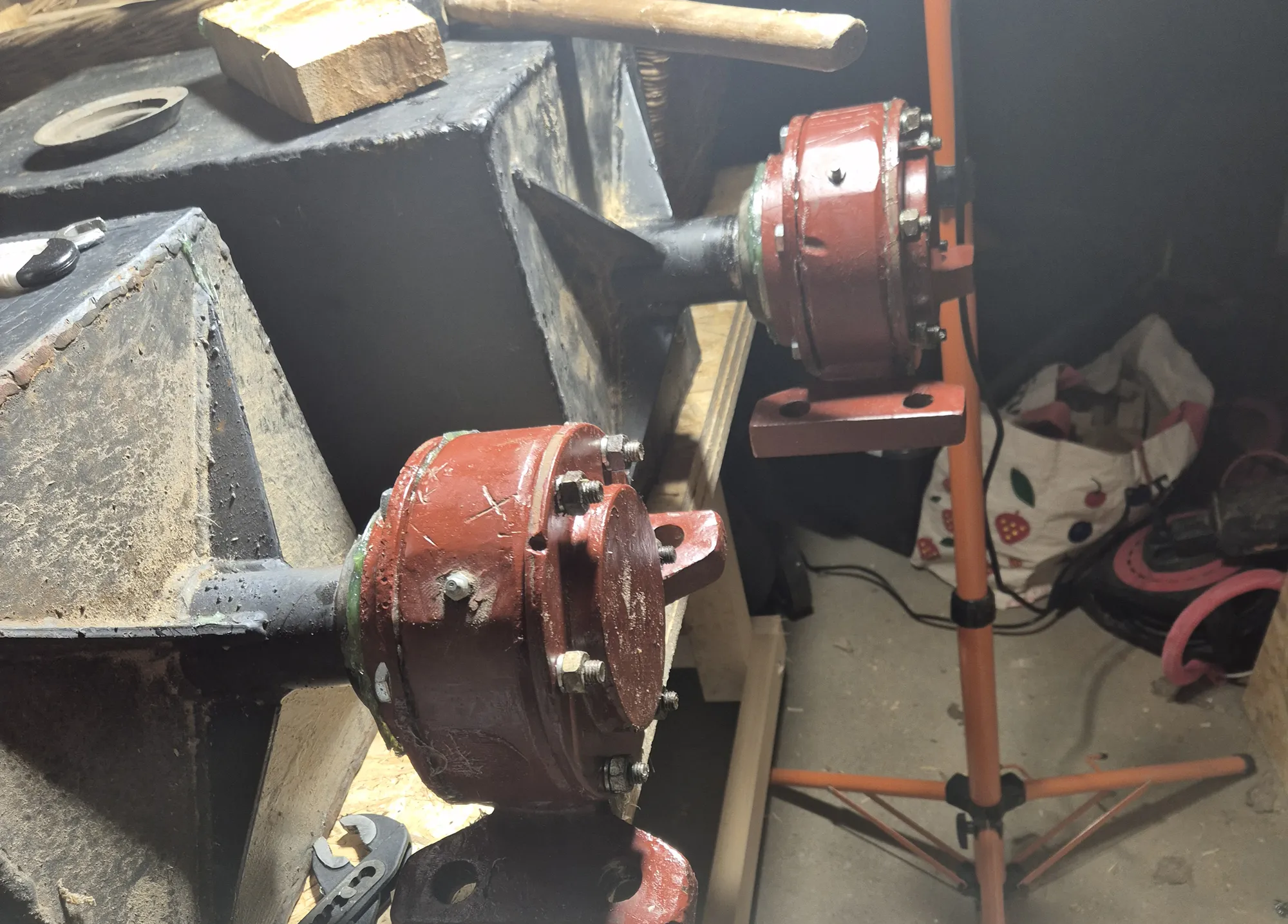
…
- rurmus project -
design changes resulting from material and safety considerations
During construction, it also became apparent that wood is a far less predictable material than steel or concrete. Each element possesses a unique arrangement of grain, knots, and internal stresses, as well as an individual response to moisture. Consequently, two seemingly identical components might behave differently once installed in the structure. This phenomenon was particularly evident in the large components of the water wheel and in the structural joints.
For this reason, the construction of the “Rurmus” adopted an approach combining historical carpentry techniques with modern safety standards. A primary objective was to showcase traditional carpentry methods; thus, extensive use was made of traditional joinery—such as mortise-and-tenon, notches, interlocking joints, dovetails, and wooden pegs.
At the same time, additional bolted connections were employed in specific locations. This applied primarily to the most heavily loaded components and to parts constantly exposed to moisture and the fluctuating forces generated during the device’s operation. Such reinforcements were used most extensively on the water wheel, which is subject to the greatest loads during operation.
The decision to use additional bolts did not stem from a lack of confidence in traditional construction methods. On the contrary, historical carpentry joints have proven their effectiveness over centuries. However, it must be remembered that builders of the past operated in a completely different context. In the past, user safety was not governed by modern regulations, technical standards, or occupational health and safety requirements. Today, the structure is intended for use by tourists, children, and school groups; therefore, the level of safety measures had to be appropriately increased. The adopted solution strikes a balance between historical reconstruction and a modern approach to safety. This made it possible to preserve the character of the original structure while ensuring a high level of durability and operational safety.
Observations made since the device was put into operation show that the *Rurmus* is not a static assembly but a dynamic technical system that responds to water volume, weather conditions, and the natural behavior of the wood.
Every element influences the operation of the whole, and changes occurring in one area may be visible in other parts of the mechanism.
Consequently, the *Rurmus* serves not only as a functional piece of machinery but also as a unique educational tool. It allows for the practical observation of the relationships between water, energy, mechanical motion, and the behavior of large wooden structures. It is precisely this opportunity for direct observation that enables the device to fulfill an important educational role, offering insight into the technical solutions employed by our ancestors.
- Education - Folklore - Culture -
Contact us—we have the knowledge, experience, and international connections.
Together, we will develop and implement your idea.