
Description of water transport in Rurmus

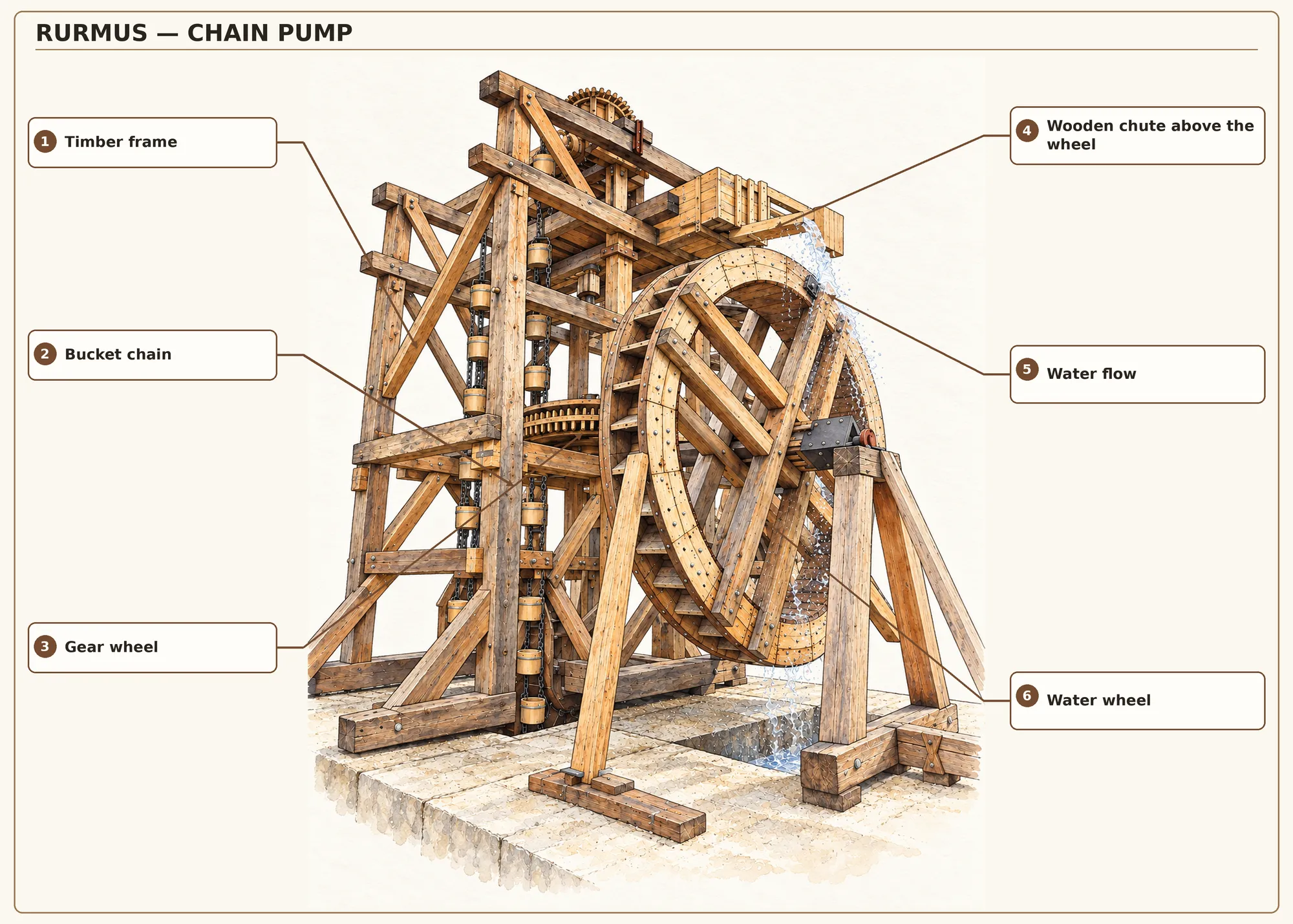
Illustration created with the help of AI
- rurmus project -
upward water transport
Water transport within the Rurmus system is a key element of the device’s operation, encompassing a sequence of processes involving water intake, lifting, storage, and subsequent flow.
The system is designed to harness the natural properties of water—specifically its weight and its ability to move under the influence of gravity.
The water transport process begins at the intake point. Depending on the specific configuration, this could be a lower reservoir, a basin, a channel, or a closed process loop. Water collects in the lower zone, from where it is directed to the lifting mechanism. Maintaining an adequate water level is crucial to ensure the effective filling of the transport components.
Water is lifted using a bucket mechanism integrated with a water wheel. Buckets are evenly spaced around the wheel’s circumference; as the wheel rotates, they submerge into the water at the system’s base, filling upon contact. The wheel’s rotation then carries the buckets upward.
Water transport at this stage is mechanical and directly linked to the operation of the water wheel. The volume of water lifted depends on bucket capacity, the number of buckets, and the wheel’s rotational speed. Properly selecting these parameters is critical to the system’s overall efficiency.
Upon reaching the highest point of rotation, the buckets empty. The water discharges into an upper reservoir, which serves as a buffer for the entire system. The reservoir must be suitably shaped to allow for the unobstructed outflow of water while minimizing losses caused by splashing.
The upper reservoir serves to store water and stabilize its flow. The water collected there can subsequently be directed to other system components or used for demonstration purposes. In educational installations, the reservoir may also be designed to be visible to users.
Water is transported further via gravity flow. It leaves the upper reservoir and is directed toward subsequent system elements, such as troughs, channels, or pipes. Traditional designs utilized hollowed-out tree trunks as water conduits; modern installations may employ other materials while still preserving the historical character of the system.
A key aspect of water transport is ensuring continuous flow. The system must be designed so that water moves without interruption and the flow rate matches the capacity of the lifting mechanism. Excess water can lead to losses, whereas a shortage results in reduced efficiency.

…
- rurmus project -
closed-loop operation
Controlling the direction of flow is also a crucial aspect of the system. Water must be conveyed in an orderly manner, without spilling outside the designated channels. To achieve this, specially shaped troughs and guides are used to direct the water stream along a specific path.
Water transport within the Rurmus system operates in a cycle. After use, the water can be returned to the lower reservoir, creating a closed-loop circuit. This approach is particularly important for demonstration installations where access to a natural water source is limited.
During transport, water losses occur due to evaporation, splashing, and system leaks. These losses must be minimized by properly sealing connections and correctly shaping the water-guiding components. Regular technical inspections ensure the system maintains high operational efficiency.
The impact of water flow velocity on system performance is another key factor. Excessive flow speed can cause operational instability, while flow that is too slow limits efficiency. Therefore, selecting appropriate system parameters and adjusting them during operation is essential.
Water transport is closely linked to the operation of the drive mechanism. Any change in water inflow directly affects the wheel’s rotational speed and, consequently, the volume of water lifted. The system thus functions as an interdependent arrangement where the various components interact with one another.
In educational installations, making the water transport process visible is also important. Components such as buckets, troughs, and reservoirs should be clearly visible to users, enabling them to understand the system’s operating principles. An open design facilitates observation and serves an educational purpose. Water transport in the Rurmus exemplifies the practical application of simple physical principles. By utilizing a bucket mechanism and gravity flow, water can be lifted and moved without external energy sources. This solution combines efficiency with simplicity of construction.
The entire water transport system must be designed as a cohesive unit. Intake, lifting, storage, and flow must work together to ensure continuous operation. Only then can the intended results be achieved and the Rurmus function correctly.
Water transport is thus not merely a technical process but an integral part of the device’s operation. Its proper design and execution determine the effectiveness of the entire system and its educational value.
- Education - Folklore - Culture -
Contact us—we have the knowledge, experience, and international connections.
Together, we will develop and implement your idea.