
Construction of the Rurmus

- rurmus project -
The construction of the “Rurmus” was an unusual undertaking from both technical and organizational standpoints. To the best knowledge of the investor and the designer, this is likely the first modern implementation of such a device on this scale in Poland. Furthermore, no information could be found confirming the existence of a similar, operational structure of comparable size elsewhere in Europe. Consequently, many solutions had to be verified directly during the construction process.
From the project preparation stage, it was anticipated that changes might be required based on insights gained during construction. All significant modifications were analyzed and implemented under the supervision of the structural designer. This was a natural consequence of building a device that lacks modern counterparts suitable for direct comparison.
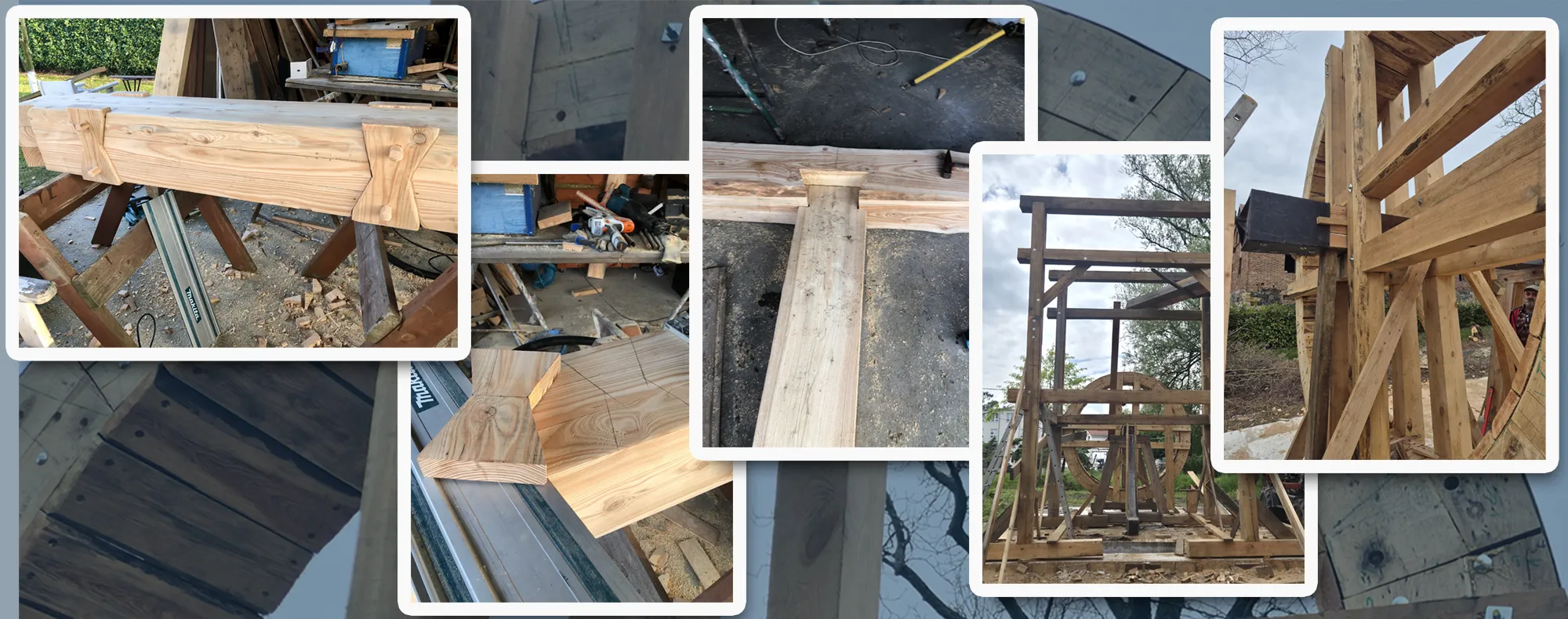
A key objective of the project was to faithfully demonstrate traditional carpentry techniques and structural solutions used in the construction of historical water-powered machinery. Accordingly, traditional carpentry joints were widely employed, including mortise-and-tenon joints, interlocking notches, dovetail joints, and wooden pegs.
However, the construction process revealed that wood remains a material that is difficult to predict fully, even for experienced builders. Unlike steel or concrete, every wooden element possesses unique properties determined by grain pattern, density, fiber orientation, moisture content, and natural stresses developed during the tree’s growth. This means that two components made from the same wood species and with identical dimensions may behave differently once installed in the structure. Furthermore, the wood reacts to changes in temperature and humidity throughout its service life; it shrinks, swells, and undergoes slight changes in shape. These phenomena were particularly evident during the assembly of large structural components and the water wheel.
Fabricating the water wheel posed a particular challenge. While it was possible to precisely prepare all the parts in the workshop, the mechanism’s behavior under actual load could only be assessed after the entire assembly was put together. Initial trials revealed a need for further adjustment of certain components and the implementation of corrections to improve the mechanism’s smooth operation.
…
- rurmus project -
installation and execution
The water wheel is the component most exposed to moisture, periodic water saturation, and fluctuating operational loads. Consequently, a greater number of bolted connections were used in many areas than originally planned. This approach aimed to enhance the structure’s durability and mitigate the effects of the wood’s natural movement during constant exposure to water.
Modifying the assembly method was another crucial stage of the project. While simpler lifting techniques were initially envisaged, the scale of the structure necessitated the use of heavy lifting equipment.
This enabled the safe and precise positioning of heavy structural components.
During construction, situations arose that required altering the assembly sequence or adjusting previously planned solutions. These changes were driven by the structure’s actual behavior and the need to ensure a precise fit between all components at full scale.
A particularly significant challenge was reconciling historical construction methods with modern safety requirements. Builders of the past focused primarily on the device’s operational efficiency; historically, occupational safety and user protection were not prioritized to the same extent as they are today. In practice, this meant that many historical structures operated without the safety features now mandated by regulations and health and safety standards.
For this reason, despite the extensive use of traditional carpentry joints, additional bolted reinforcements were incorporated in specific locations. These measures were implemented solely where required by modern safety standards, structural analysis, or the need to protect future users of the facility. Their use does not alter the structure’s historical character, yet it significantly enhances operational safety.
All implementation decisions were made with respect for historical precedents and in adherence to the overriding principle that the structure should serve not merely as a technical reconstruction but also as a safe educational facility for tourists, children, and school groups.
The experience gained during construction demonstrates that the realization of the *Rurmus* was not a simple reproduction based on existing historical documentation. It was a process that required continuous analysis of the structure’s behavior, the making of technical decisions, and the adaptation of solutions to actual site conditions and operational requirements.
It is precisely these experiences that constitute one of the project’s greatest educational values. They demonstrate that historical construction was not only a craft but also an art of practically solving technical problems. The *Rurmus* exemplifies the integration of the expertise of master carpenters from the past with modern design knowledge and safety standards.
- Education - Folklore - Culture -
Contact us—we have the knowledge, experience, and international connections.
Together, we will develop and implement your idea.